
.svg)
Strengthening Your Biobank Catalogue With Expert Pathology
Expert pathology and AI-enabled workflows help biobanks deliver quality-confirmed, well-characterised specimens. Diagnexia Analytix provides scalable subspecialist support to build trusted catalogues for precision medicine and biomarker research.
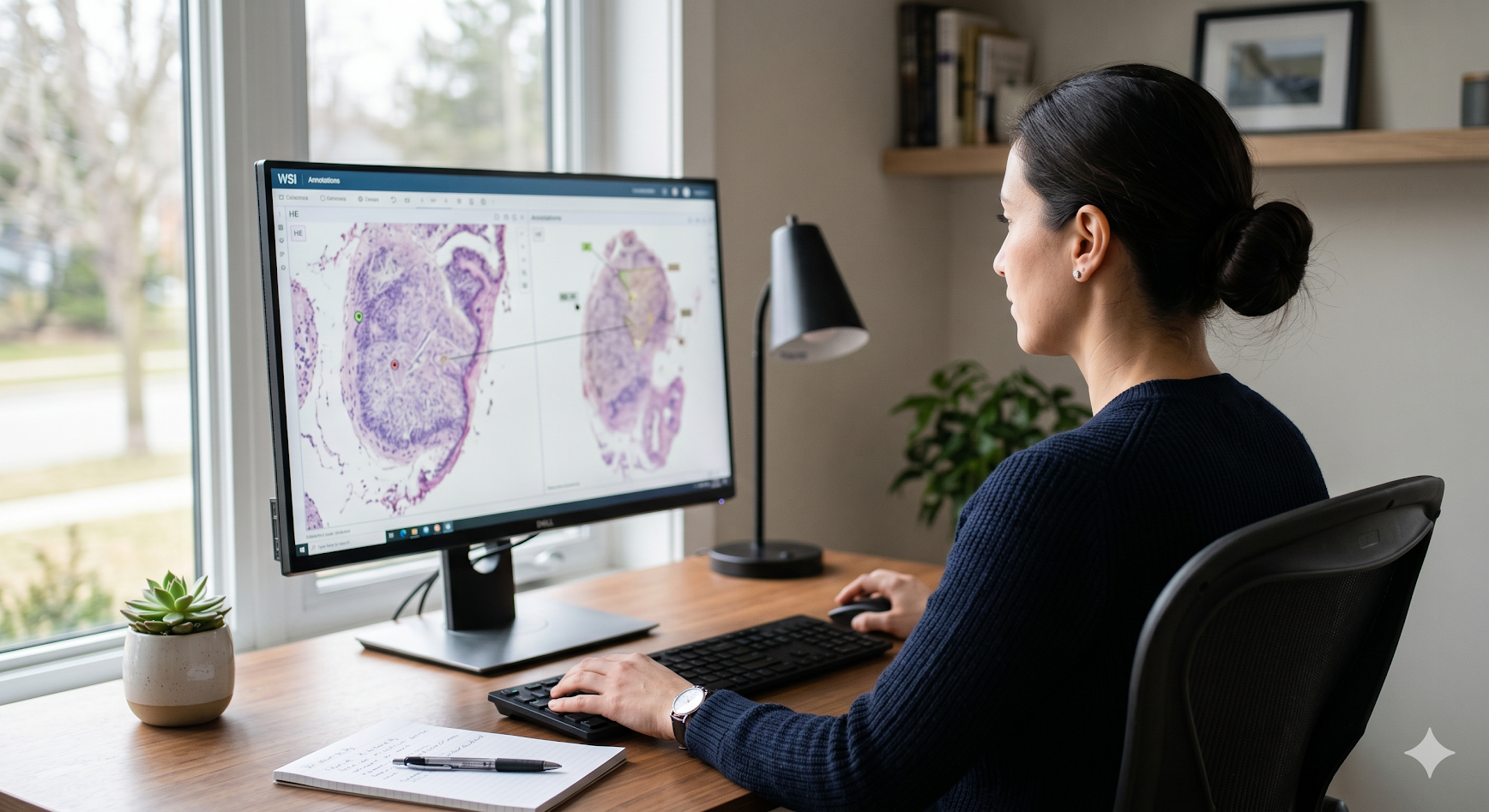
Building the pathology foundation that biopharma clients depend on
The demand for characterised, research-grade tissue has never been stronger. Biopharma teams running precision medicine programmes, biomarker validation studies, and companion diagnostic development are actively seeking biobank partners who can deliver specimens with the quality assurance their downstream science requires. For biobanks positioned to meet that standard, the commercial and reputational opportunity is significant.
Meeting it consistently, however, requires pathology infrastructure that many biobanks have not yet had the resource or strategic focus to build. The challenge now is that buyer expectations have shifted, and the gap between what biopharma clients require and what most collections can demonstrate is widening. Building a catalogue that commands confidence starts with understanding where the gap lies, and how to close it.
What Biopharma Clients Are Actually Evaluating
When a research team purchases tissue from a biobank, they are making an assumption: that the specimen is what it claims to be, that target cells are present in sufficient quantity, and that the annotation is adequate to guide their downstream decisions. If that assumption fails at the assay stage, the project stalls, and confidence in the source erodes.
A 2023 conjoint study published in Nature's Scientific Reports found that specimen quality and specimen characterisation together accounted for nearly half of the relative importance buyers assign when evaluating biobank providers. For teams conducting IHC scoring or biomarker validation, tissue that fails cellularity requirements does not just cause delay. It raises questions about the reliability of the catalogue as a whole.
The good news is that this is precisely the area where investment in expert pathology delivers the clearest and most measurable return.
The Pathology Gaps Worth Prioritising
If you are managing a large repository or prospectively sourcing tissue across multiple institutions, these are the pressure points you will recognise:
- Specimen quality confirmation at the point of release: Tumour cellularity, tissue integrity, and the presence of target cell populations all require structured pathologist review to confirm. Where that review is applied consistently, specimens released to biopharma clients arrive ready for research use rather than requiring re-evaluation.
- Annotation depth aligned with research utility: Subspecialist pathologists bring the domain knowledge to annotate tissue in a way that is structured, consistent, and directly usable for downstream biopharma applications. Where that expertise is applied at the point of quality review, specimens arrive with annotations that research teams can act on with confidence, rather than requiring interpretation or supplementary review at their end.
- Subspecialist coverage across therapeutic areas: If your collection spans oncology, autoimmune disease, and rare indications, you already know the challenge of maintaining consistent expert review across all of them. On-demand access to the right domain expertise, at the right point in your workflow, is a more sustainable model than trying to build every specialism in-house.
Building a Catalogue That Biopharma Can Trust

What most biobanks need is not a new internal department. They need consistent, on-demand access to the right expertise, applied at the right point in their workflow, with the flexibility to scale as project demands evolve.
Diagnexia Analytix operates as an embedded pathology partner for biobank teams, combining a global network of over 250 subspecialist pathologists with AI-enabled digital workflows.
That means named experts with genuine domain knowledge reviewing specimens across oncology, autoimmune, rare disease, and other therapeutic areas, without the overhead of building those capabilities in-house.
It means standardised scoring frameworks developed collaboratively with your team, so that cellularity data, tissue composition, and biomarker-relevant assessments are documented in a format your biopharma clients can act on directly. It means fast turnaround times that keep your catalogue moving and your clients confident, supported by AI-powered quality control that ensures consistency across all programmes, with the pathologist remaining the scientific authority on every decision.
Whether you need a single feasibility review or ongoing support across a high-volume programme, the engagement model is designed to flex with your needs and your timelines.
Making Pathology a Strength
The biobanks that will define the next decade of translational research are not simply the ones with the largest collections. They are the ones whose collections can be trusted.
Trust comes from expert review, standardised annotation, and reproducible quality assurance that holds up when a biopharma client needs to defend their data. Diagnexia Analytix provides that expertise, at scale, as an embedded extension of your team.
Let's start with a short consultation to map the pathology opportunities in your current collection.

Related posts
Strengthening Your Biobank Catalogue With Expert Pathology
Your Guide to Pathology Outsourcing for Precision Medicine